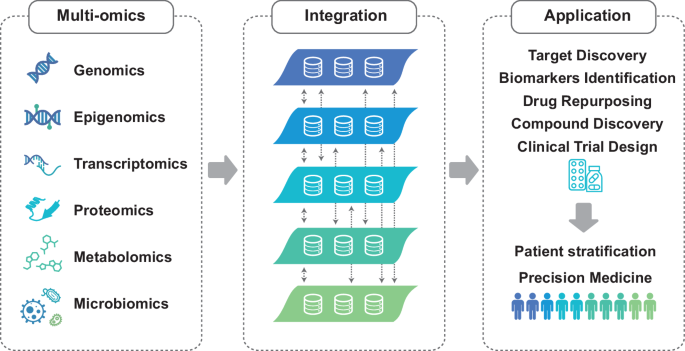
Introduction Contemporary pharmaceutical development persists as an exceptionally high-risk venture characterized by clinical trial attrition rates that now exceed 90% and aggregate expenditures that have risen to an average of 2.6 billion USD for every therapeutic that ultimately secures marketing approval.1 These staggering metrics reflect more than escalating expenses in labor, materials, and regulatory compliance;
Interns cracking the code on making robotics course accessible to online students – GCU News
Photos by Ralph Freso/GCU News
Imagine a robot is idle in a corner of the College of Engineering and Technology’s Robotics Lab, passively and quietly minding its own business.
Then, it suddenly switches on, scooting, then plodding, then barreling forward.
You’re the reason why.
The brilliance of it is this: You’re not even in the room.
You’re somewhere in Minnesota, or Oklahoma or Colorado, and you’ve just deployed your previously tested code – code you’ve refined in a lab simulation, remotely from Minnesota, or Oklahoma or Colorado.
And now you’re controlling the robot, also remotely, from your bedroom or living room – in Minnesota, or Oklahoma or Colorado.
It’s not something left to the imagination, at least at Grand Canyon University.
It’s something a trio of intrepid student technophiles are making happen this summer, under the helm of computer science associate professor Dr. Isac Artzi.
He’s mentoring a small-but-mighty team of five student interns in the Engineering Building’s Artificial Intelligence and Virtual Reality Lab who are plugging away, up to 40 hours a week, to bring a gaggle of tech projects to life this summer.
The mission some in the group have chosen to accept: one, create an AI-driven robotics learning environment for students; and two, create an AI-driven simulation so students can test the AI code they’ve written before deploying the code on an actual robot in the classroom.
The Robotics Lab, the software students are building to program the robots, the hardware, and the code-testing simulation are part of the latest evolution of the College of Engineering and Technology’s Bachelor of Science in AI.
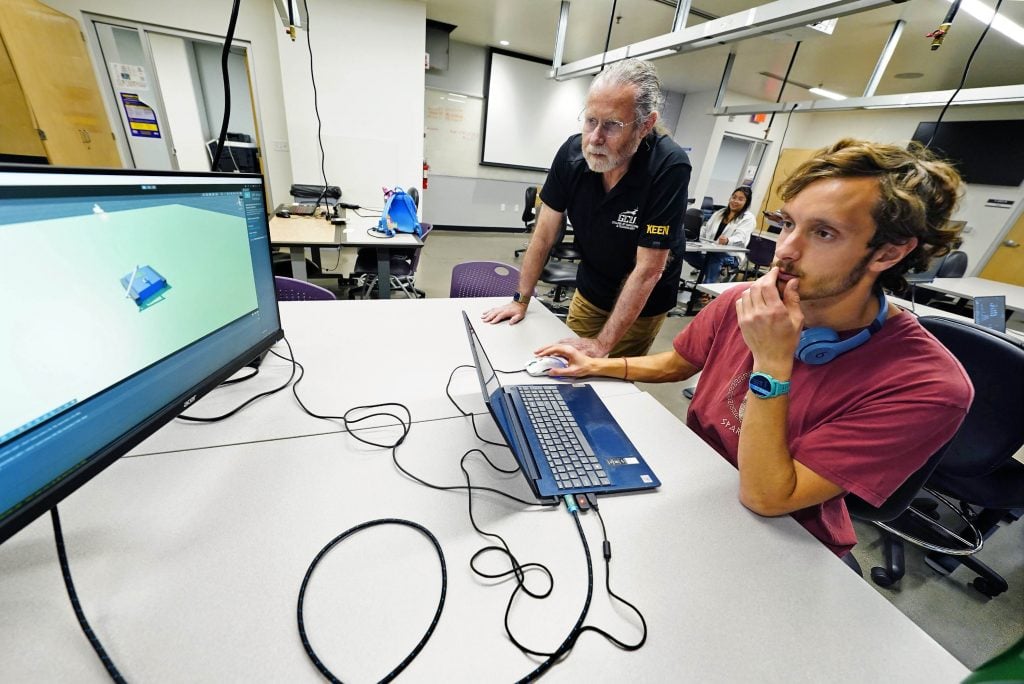
The college launched the burgeoning AI undergraduate program in fall 2025 – the school also offers a new master’s degree in AI – that includes coursework such as machine learning, computer vision, ethical frameworks, natural language processing and, of course, robotics. Students in the program engage with the science behind how machines learn, adapt and make decisions.
Students expressed an interest in an AI degree, but also, “Many universities are riding the wave of AI,” Artzi said after the AI degrees were launched.
GCU wants to be at the crest of that wave.
The AI undergraduate program is offered to students studying on campus, but it also is offered fully online.
Which brings up this pickle: How do you offer a robotics course to students who aren’t physically in the classroom?
Well, through technology, of course – through autonomous robots controlled remotely.
“It’s basically getting online students to be able to participate in this course. It’s the most important thing about this project,” said Alberto Felix Castro, one of the students who has been working on the project just since May.
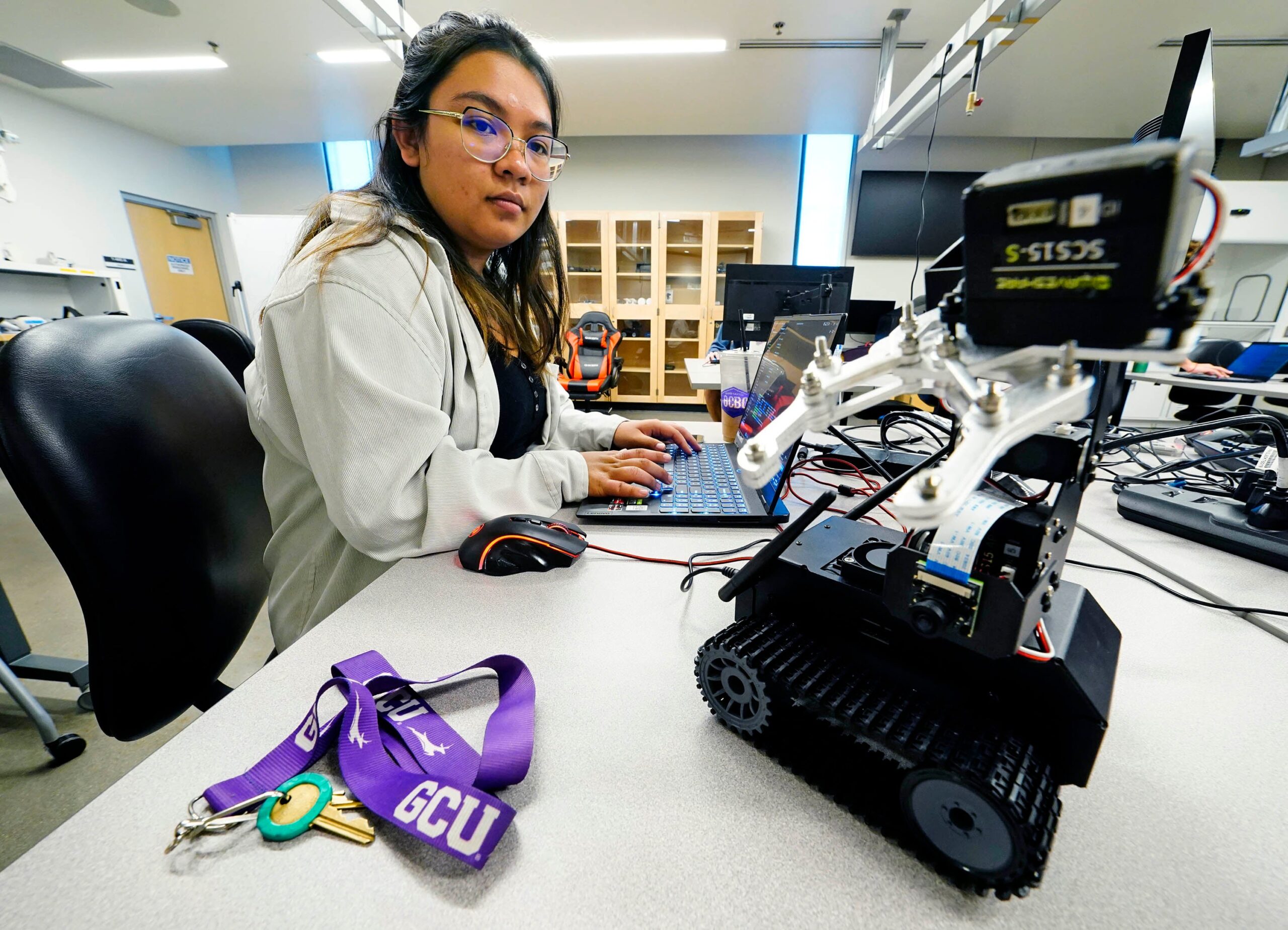
Busy bees Ysabelle Trinidad, along with teammates Stylianos Regas and Felix Castro, chatted it up on Monday afternoon in the Engineering Building’s fourth-floor AI/VR Lab, with Trinidad seated next to the Jetson Nano Jet Tank. The AI-powered, tracked mobile robot is what students will run complex robotics applications on – whether in the lab or remotely from a different location – when the fall semester starts.
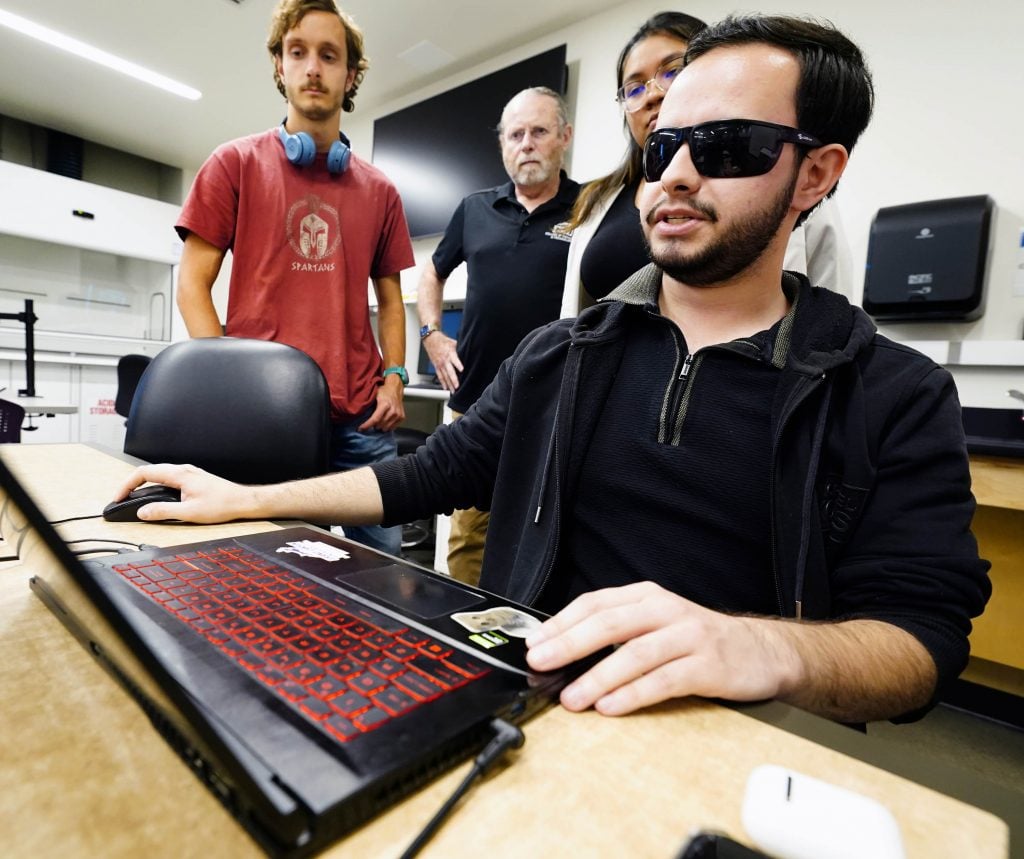
The robots will execute deep learning and allow autonomous navigation and real-time vision – at least they will once the students complete their projects.
“There’s the actual development of the robot, there’s the online aspect so students can use a simulator (to test their code), then there’s the actual user interface students are going to be using so they can access the robot remotely,” Trinidad said of the project.
The three are splitting the job for efficiency’s sake and have made significant inroads since the beginning of the summer.
Trinidad is working on the software that students will use to upload their files into the robot remotely.
“If the student is online, if they want to be able to access the robot, there needs to be some sort of software and user interface so they will be able to access the robot and test their code,” she said.
Trinidad has been working on that physical testing environment alongside Felix Castro.
While she is concentrating on what happens as instructions travel from a credit-card sized computer called a Raspberry Pi to the robot, Felix Castro has been working on what happens remotely, when commands come into the lab from anywhere in the world to the Raspberry Pi. He is building the user interface that students will use.
On Monday, he input a couple of commands into his computer from one side of the lab.
It’s basically getting online students to be able to participate in this course. It’s the most important thing about this project.
Compuer science senior Alberto Felix Castro,
summer intern in the AI/VR Lab
“Give it a second …. Now the server is running on the Pi over there,” he said, as he jogs to another area of the lab. “Now I take the IP address and go onto Chrome, paste it in there. Now we are on the website that we’re going to use to upload files on the Raspberry Pi over there.”
“He’s been doing that all summer,” said one of the students of Felix Castro running back and forth from laptop to Raspberry Pi and vice versa, over and over again. He wants to make sure what the student will type in on their laptop is arriving at the right place in the system and working properly.
He displays the dashboard those students will see.
“You’ll have a camera,” he said, “so you can kind of see what the robot is doing if you’re not in the lab. And here’s where you’re going to upload the files. That’s how we upload files from anywhere onto the Raspberry Pi, which will then be uploaded into the robot.”
Trinidad is concerning herself with how that code will be distributed, “because there’s going to be multiple robots,” she said, “and they (students) are only supposed to be able to access one robot at a time. The program needs to know which robot it wants to access, and it has to have the ability to execute it (the commands to the robot) once it gets uploaded.”
Regas, meanwhile, has been working on the virtual testing environment, where students will input commands from an external command window into Unity, the cross-platform video game development engine, “so students can test their scripts (a specific type of coding) before they actually try it on the robots.”
That part is important, Trinidad said, because of classroom time constraints. Thirty minutes isn’t enough time for a student to be able to test their codes on the robots, then realize something is wrong, debug the code and run it again.
“The completely virtual component is really imperative for students to be able to test their code so once they’re able to access the robot, there is minimal change they need to put into the actual code,” she said.
The goal is for students to have a fully executable code by the time they have their 30 minutes with the robot.
Regas also created a Wikidot, where everything students would need to know in working with these robots is kept: a step-by-step guide of how the robot works, how the code works, along with information about the hardware and software.
Not that everything has run as smoothly as butter. For one, students are working with campus IT security on a Wi-Fi issue to make sure the robots will be able to connect to the Wi-Fi without being blocked.
All three students heard about the project from Artzi, who told them, “We have this really big project we want students to work on.”
Trinidad wasn’t intimidated; she was all in.
Not only is it a paid summer intern job, “but we’ll have the experience we need for future jobs,” she said.
“We’re looking at any opportunity, really, to gain some experience,” Regas added. “It seemed like a no-brainer: ‘I guess I know what I’m doing this summer.’”
Artzi said a few months ago, a company approached his college and pitched a solution to them for a trio of robots that cost $60,000.
“I inquired a little bit, and I said, ‘You know what? That’s nonsense,’ ” Artzi said. “I did an experiment on how to do the same thing with 100% free tools. …In the end, once the project wraps up by the end of the summer. We’re basically building the $60,000 (solution the company pitched) with the students for a few hundred dollars.”
The robot project is the seed for just one of what could be three potential startups.
Artzi said the students have taken the project and fleshed it out. Their work will make a significant impact in the college and with their fellow students, who have provided the vision, the outline and the idea.
“The students are the hero,” he said.
Manager of internal communications Lana Sweeten-Shults can be reached at [email protected].
***
Related content:
GCU News: From rock climbing to the NBA, students display their deep learning at AI event
GCU News: Building a quest in virtual reality? Game on

Related Posts